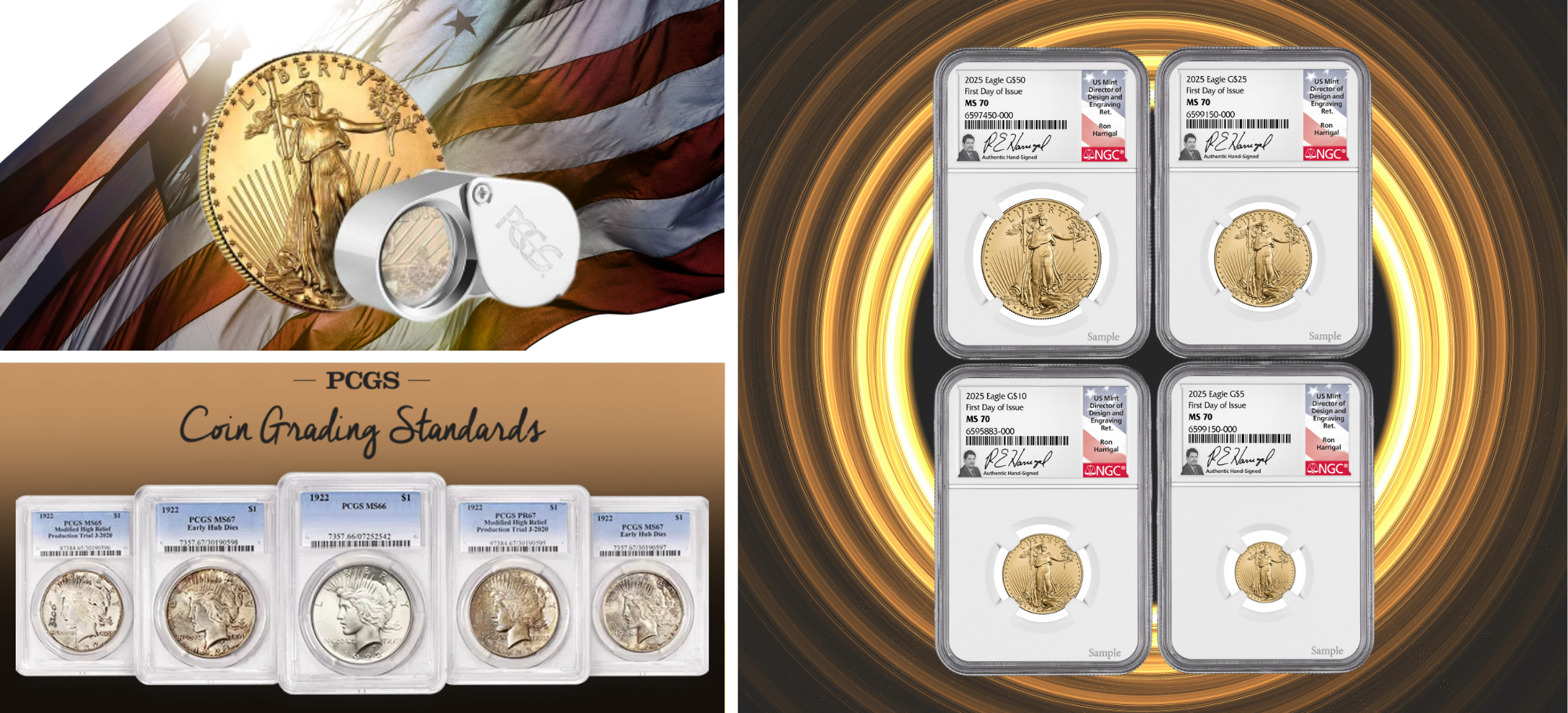
In the world of numismatics, condition is everything. The difference between a $20 coin and a $2,000 coin can come down to the smallest scratch or slightest wear. That’s where coin grading comes in—and it all started with a collector and a clever idea.
Back in 1949, Dr. William H. Sheldon introduced a revolutionary way to assess coin condition with what he called a “Quantitative Scale for Condition.” Designed specifically for U.S. Large Cents, Sheldon’s system used a 70-point scale to link a coin’s quality to its market value. His theory was simple: a coin in pristine condition from a common year could fetch about 70 times more than the same coin in poor shape. This idea laid the groundwork for modern coin grading.
It wasn’t until 1977 that the scale became a true industry standard, thanks to the American Numismatic Association’s (ANA) Grading Standards. The ANA formalized Sheldon’s approach, refining it for clarity and applying it to all U.S. coins. Today, the 70-point Sheldon Scale is the universal benchmark for grading coins—used by collectors, dealers, and grading services worldwide.
MODERN-DAY COIN GRADING SCALE
Label |
Grade |
Definition |
MS/PR-70 |
Mint State or Proof 70 |
The finest quality possible, with no evidence of scratches or imperfections under 5x magnification. |
MS/PR-69 |
Mint State or Proof 69 |
A fully struck coin with nearly imperceptible imperfections. |
MS/PR-68 |
Mint State or Proof 68 |
Very sharply struck with only minuscule imperfections. |
MS/PR-67 |
Mint State or Proof 67 |
Sharply struck with only a few imperfections. |
MS/PR-66 |
Mint State or Proof 66 |
Very well struck with minimal marks and hairlines. |
MS/PR-65 |
Mint State or Proof 65 |
Well struck with moderate marks or hairlines. |
MS/PR-64 |
Mint State or Proof 64 |
Above average strike; minor marks, mostly outside of focal areas |
MS/PR-63 |
Mint State or Proof 63 |
Average or better strike; scattered marks, though none severe |
MS/PR-62 |
Mint State or Proof 62 |
Slightly weak or average strike with no trace of wear. More or larger abrasions than an MS/PF 63. |
MS/PR-61 |
Mint State or Proof 61 |
Weak or average strike with no trace of wear. More marks and/or multiple large abrasions. |
MS/PR-60 |
Mint State or Proof 60 |
Weak or average strike with no trace of wear. Numerous abrasions, hairlines and/or large marks. |
AU-58 |
About Uncirculated 58 |
Slight wear on the highest points of the design. Full details. |
AU-55 |
About Uncirculated 55 |
Slight wear on less than 50% of the design. Full details. |
AU-53 |
About Uncirculated 53 |
Slight wear on more than 50% of the design. Full details, very minor softness on the high points. |
AU-50 |
About Uncirculated 50 |
Slight wear on more than 50% of the design. Full details, minor softness on the high points. |
XF-45 |
Extremely Fine 45 |
Complete details with minor wear on some of the high points. |
XF-40 |
Extremely Fine 40 |
Complete details with minor wear on most of the high points. |
VF-35 |
Very Fine 35 |
Complete details with wear on all of the high points. |
VF-30 |
Very Fine 30 |
Nearly complete details with moderate softness on the design areas |
VF-25 |
Very Fine 25 |
Nearly complete details with more softness on the design areas. |
VF-20 |
Very Fine 20 |
Moderate design detail with sharp letters and digits. |
F-15 |
Fine 15 |
Recessed areas show slight softness. Letters and digits are sharp. |
F-12 |
Fine 12 |
Recessed areas show more softness. Letters and digits are sharp. |
VG-10 |
Very Good 10 |
Wear throughout the design. Letters and digits show softness. |
VG-8 |
Very Good 8 |
Wear throughout the design. Letters and digits show more softness. |
G-6 |
Good 6 |
Peripheral letters and digits are full. Rims are sharp. |
G-4 |
Good 4 |
Peripheral letters and digits are nearly full. Rims exhibit wear. |
AG-3 |
About Good 3 |
Most letters and digits are readable. Rims are worn into the fields. |
FR-2 |
Fair 2 |
Some details are visible. Rims are barely visible. |
PO-1 |
Poor 1 |
Enough detail to identify the coin’s date and type. Rims are flat or nearly flat. |
None |
Ungradable |
Date and mintmark must be detectable to be graded |